 |
Research
Open-Access, Low Magnetic Field Polarized gas Pulmonary MRI
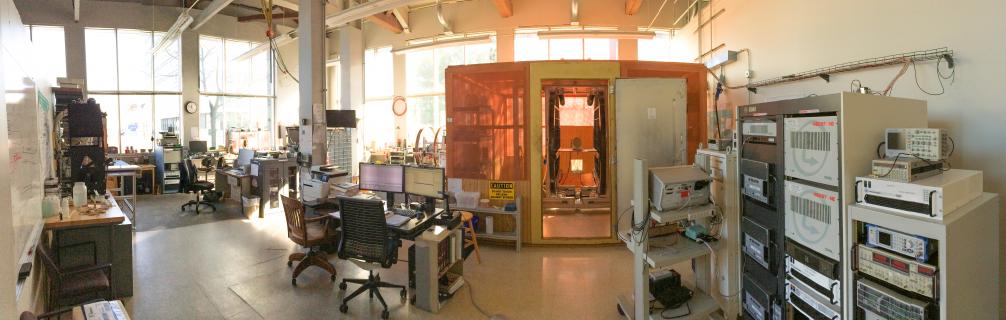
We are developing a novel biomedical imaging technology: magnetic resonance imaging (MRI) of hyperpolarized noble gas (3He) inhaled into human lungs at low magnetic fields (less than 10 mT). This technology will allow MRI studies of human ventilation in a simple, low-cost system with an open geometry (i.e., with the person standing, sitting, or lying down) and without the problems of high magnetic fields for people with implants, pacemakers, etc.
We are applying this open-access MRI to studies of pulmonary physiology, e.g., mapping ventilation and pulmonary oxygen concentration as a function of body orientation in the gravitational field. In the future, this technology may enable small, portable, low-field MRI systems with important uses such as imaging the underdeveloped lungs of premature infants, who often suffer from pulmonary problems and cannot be moved from the neonatal intensive care unit to a conventional MRI scanner.
Low-field MRI is made practical by the process of noble gas "hyperpolarization". In this laser optical pumping process, the NMR signal of noble gases such as 3He and 129Xe can be increased by four to five orders of magnitude by increasing the atoms' nuclear spin polarization. In addition to MRI of human lungs, there are many important applications of hyperpolarized noble gas NMR in the physical sciences - some of which are pursued by our group and described on other pages.
A novel feature of hyperpolarized noble gas is that it enables high-sensitivity MRI at low magnetic fields, because the polarization is induced optically, prior to the MRI procedure, rather than by thermal equilibrium in the presence of a large magnetic field. The large magnetic fields of conventional human MRI instruments typically require a large, heavy, and expensive superconducting magnet which often restricts the imaging subject to lie flat inside a tight tube. At low magnetic fields, however, it is possible to image hyperpolarized noble gas using a simple, open electromagnet and achieve similar resolution (1 mm) to that obtained at high fields, as our group first demonstrated for small samples in a home-built MRI system operating at 0.002 tesla.
New Methods of Low Field Magnetic Resonance Imaging for Applications to Traumatic Brain Injury
This applied research program builds on recent advances by our collaboration in the development of novel methods of low-magnetic-field MRI and advanced MRI hardware
Without major innovation, high-field MRI instruments offer limited utility for imaging TBI in widely deployable contexts. We focus our research effort on the high-risk and critical challenges that must be solved to enable deployment of a transportable human-head MRI system applicable to TBI imaging in battlefield medical facilities. Our goal is to establish proof-of-principle of a suite of techniques and technologies to advise future development of a field-deployable device with high diagnostic impact.
Long lived NMR singlet states for bioimaging
New and novel spin-polarization techniques
|