Out of Office is a recurring feature on the MGB Vitals intranet highlighting members of the Mass General Brigham community with surprising, fascinating and inspiring endeavors outside of work.
Name: Giorgio Bonmassar, PhD
Day job: I am a faculty investigator at the Athinoula A. Martinos Center for Biomedical Imaging at Massachusetts General Hospital and an associate professor of Radiology at Harvard Medical School. I direct the Analog Brain Imaging (ABI) Laboratory, where my research focuses on developing advanced biomedical technologies to study and modulate brain activity. My work integrates neuroengineering, MRI technology, electrophysiology and bioelectromagnetic modeling to create novel systems for brain imaging and neuromodulation, including MRI-compatible electrophysiology devices, micromagnetic stimulation technologies and computational tools for analyzing electromagnetic interactions with neural tissue.
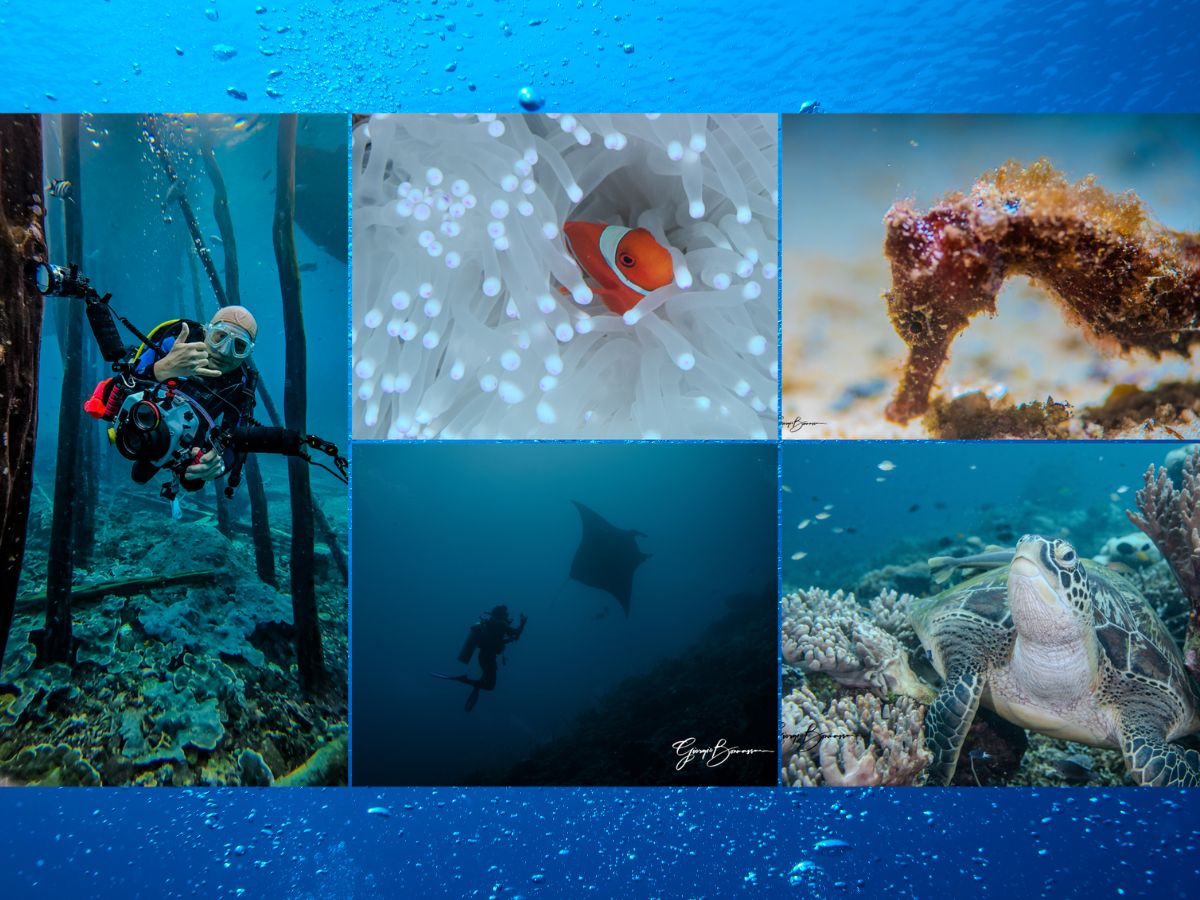
What is your Out of Office activity? Outside of my professional activities, one of my main passions is underwater photography. A successful underwater photographer must combine many roles simultaneously: diver, explorer, lighting technician, naturalist, conservationist, marine biologist, marine archaeologist, engineer, mechanic and artist. It is a genre of photography that challenges both the photographer and the equipment like few others, yet it is immensely rewarding to master. A recent milestone for me was being highlighted on the website of Ikelite, a well-known manufacturer of underwater camera housings and equipment, which featured my work among examples of underwater photography.
I also recently took a diving trip to Raja Ampat. Located in the Indonesian province of West Papua, Raja Ampat is widely regarded as one of the most biodiverse marine ecosystems on Earth. The archipelago consists of more than 1,500 small islands, cays and shoals surrounding the four main islands of Waigeo, Batanta, Salawati and Misool. Its reefs lie within the Coral Triangle and host an extraordinary concentration of marine life, including over 600 species of hard coral and more than 1,500 species of reef fish. Because of its pristine reefs, strong conservation efforts and dramatic limestone island landscapes, Raja Ampat has become a premier destination for scientific study, underwater photography and world-class scuba diving.
How did you get into this? I have been diving for over 30 years, and photography has been a passion of mine since I was a teenager, when I used to develop black-and-white photographs in my basement darkroom. Combining these two interests, I began experimenting with underwater photography early on during my diving trips. However, a recent upgrade to a modern digital camera system with dedicated underwater strobes and improved housing significantly expanded my capabilities and allowed my underwater photography to take a substantial leap forward.
How does this pursuit intersect with your professional life? There is a strong connection between my professional life and underwater photography. As someone working in the field of radiology, images are naturally at the heart of what I do. More broadly, as a scientist, I believe that powerful and visually compelling images help communicate complex ideas much more effectively, especially to a wider audience beyond the scientific community.
In underwater photography, lighting is the most critical element because it defines mood and reveals the scene. At depth, there is very little natural color, so the photographer must bring light underwater and learn how to shape it — adjusting its direction and quality (hard or soft) to reveal structures, textures and three-dimensional form. In many ways, this mirrors my research, where I work to shape and control electromagnetic fields in order to modulate the central or peripheral nervous system, enabling us to study brain function and develop new therapies for patients.
Composition also creates an interesting parallel. An underwater photographer must arrange visual elements quickly — using principles such as the rule of thirds, balance and framing — often within seconds, since diving conditions and safety constraints limit the time available to capture an image. Similarly, in my professional work, safety is always the highest priority, both for research participants and for the researchers themselves. A compelling photograph requires a clear subject and often captures a “decisive moment” that tells a story; the same is true of scientific manuscripts and grant proposals, which must present a clear central idea supported by strong evidence.
In photography, we often use color contrast or tonal balance to evoke emotions, but underwater, these colors only appear when the photographer brings their own light. In a similar way, scientific discovery often feels like bringing new light to something previously unseen. Just as photographers seek unique viewpoints and perspectives, I encourage my lab to approach scientific problems from new angles, because fresh perspectives are often where the most interesting discoveries emerge.
